exploring the eye’s mind

An incomplete reading list...
I’m asked for a reading list on occasion. The following list are some articles and books that I recommend (and frequently cite) that tie together photojournalism with psychology - or, alternately, are just good works concerning photojournalism.
Ang, T. (2000). Picture editing (2nd ed.). Oxford, [England]: Focal Press.
Balluerka, N. (1995). The influence of instructions, outlines, and illustrations on the comprehension and recall of scientific texts. Contemporary Educational Psychology, 20, 369-375.
Barrett, A. W., & Barrington, L. W. (2005). Bias in newspaper photograph selection. Political Research Quarterly, 58, 609-618.
Baumeister, R., Bratslavsky, E., Finkenauer, C., & Vohs, K. D. (2001). Bad is stronger than good. Review of General Psychology, 5, 323-370.
Bell, B., & Loftus, E. (1985). Vivid persuasion in the courtroom. Journal of Personality Assessment, 49, 659.
Bodenhausen, G. V., & Wyer, R. S. (1985). Effects of stereotypes in decision making and information-processing strategies. Journal of Personality and Social Psychology, 48, 267-282.
Bohannon, J. N. (1988). Flashbulb memories for the space shuttle disaster: A tale of two theories. Cognition, 29, 179-196.
Bright, D. A., & Goodman-Delahunty, J. (2004). The influence of gruesome verbal evidence on mock juror verdicts. Psychiatry. Psychology And Law, 11, 154-166.
Bright, D. A., & Goodman-Delahunty, J. (2006). Gruesome evidence and emotion: anger, blame, and jury decision-making. Law and Human Behavior, 30, 183-202.
Brown, R., & Kulik, J. (1977). Flashbulb memories. Cognition, 5, 73-99.
Columb, C., & Plant, E. A. (2011). Revisiting the Obama Effect: Exposure to Obama reduces implicit prejudice. Journal of Experimental Social Psychology, 47, 499-501.
Conway, A. R. A., Skitka, L. J., Hemmerich, J. A., & Kershaw, T. C. (2009). Flashbulb memory for 11 September 2001. Applied Cognitive Psychology, 23, 605-623.
Cooper, R., Potter, W. J., & Dupagne, M. (1994). A status report on methods used in mass communication research. Journalism Educator, 48, 54-61.
Dahmen, N. S. (2009). Snowflake White and Politically Right: Photographic Framing in News Media Coverage of Stem Cell Research. Visual Communication Quarterly, 16, 18-31.
de Gelder, B. (2000). More to Seeing than Meets the Eye. Science, 289, 1148-1149.
Dion, K., Berscheid, E., & Walster, E. (1972). What is beautiful is good. Journal of Personality and Social Psychology, 24, 285-290.
Domke, D., Perlmutter, D., & Spratt, M. (2002). The primes of our times? An examination of the ‘power’ of visual images. Journalism, 3, 131-159.
Douglas, K. S., Lyon, D. R., & Ogloff, J. R. (1997). The impact of graphic photographic evidence on mock jurors' decisions in a murder trial: probative or prejudicial? Law and Human Behavior, 21, 485-501.
Eagly, A. H., Ashmore, R. D., Makhijani, M. G., & Longo, L. C. (1991). What is beautiful is good, but...: A meta-analytic review of research on the physical attractiveness stereotype. Psychological Bulletin, 110, 109-128.
Elliott, D. (2003). Moral responsibilities and the power of pictures. In P. M. Lester & S. D. Ross (Eds.), Images that injure : pictorial stereotypes in the media (2nd ed., pp. 7-21). Westport, Conn. ; London: Praeger.
Essen, D. C. V., Anderson, C. H., & Felleman, D. J. (1992). Information Processing in the Primate Visual System: An Integrated Systems Perspective. Science, 255, 419-423.
Evans, H., & Taylor, E. (1978). Pictures on a page : photo-journalism, graphics and picture editing. New York: Holt, Rinehart and Winston.
Feigenson, N. (2010). Emotional influences on judgments of legal blame: How they happen, whether they should, and what to do about it. In B. H. Bornstein & R. L. Wiener (Eds.), Emotion and the law : psychological perspectives (pp. 45-96). New York: Springer.
Feingold, A. (1992). Good-looking people are not what we think. Psychological Bulletin, 111, 304-341.
Gardner, D. (2009). The science of fear: How the culture of fear manipulates your brain. New York: Plume.
Garner, R., Brown, R., Sanders, S., & Manke, D. (1992). "Seductive details" and learning from text. In K. A. Renninger, S. Hidi & A. Krapp (Eds.), The Role of interest in learning and development (pp. 239-254). Hillsdale, N.J.: L. Erlbaum Associates.
Garner, R., Gillingham, M., & White, C. S. (1989). Effects of "Seductive Details" on Macroprocessing and Microprocessing in Adults and Children. Cognition and Instruction, 6, 41-57.
Goldberg, V. (1991). The power of photography: how photographs changed our lives (1st ed.). New York: Abbeville Press.
Greenberg, B. (1986). Minorities and the mass media. In J. Bryant & D. Zillmann (Eds.), Perspectives on media effects (pp. 165-188). Hillsdale, N.J.: L. Erlbaum Associates.
Greenberg, B., Mastro, D., & Brand, J. E. (2002). Minorities and the mass media: Television into the 21st century Media effects: Advances in theory and research (2nd ed.). (pp. 333-351): Mahwah, NJ, US: Lawrence Erlbaum Associates Publishers.
Greene, E., & Bornstein, B. H. (2003). Determining damages: the psychology of jury awards (1st. ed.). Washington, DC: American Psychological Association.
Harp, S., & Mayer, R. (1997). The role of interest in learning from scientific text and illustrations: On the distinction between emotional interest and cognitive interest. Journal of educational psychology, 89, 92-102.
Harp, S., & Mayer, R. (1998). How seductive details do their damage: A theory of cognitive interest in science learning. Journal of educational psychology, 90, 414-434.
Hassin, R., & Trope, Y. (2000). Facing faces: Studies on the cognitive aspects of physiognomy. Journal of Personality and Social Psychology, 78, 837-852.
Hastie, R. (1986). A primer of Information-Processing Theory for the political scientist. In R. R. Lau & D. O. Sears (Eds.), Political cognition: the 19th Annual Carnegie Symposium on Cognition (pp. 11-39). Hillsdale, N.J.: L. Erlbaum Associates.
Hoffman, D. D. (1998). Visual intelligence: how we create what we see (1st ed.). New York: W.W. Norton.
Hyman, J. I. E., & Loftus, E. F. (1998). Errors in autobiographical memory. Clinical Psychology Review, 18, 933-947.
Jaffe, E. (2008). About face. Observer, 21(2). Retrieved from http://www.psychologicalscience.org/index.php/publications/observer/2008/february-08/about-face.html
Jaffe, E. (2012). Piecing together performance. Observer, 25(7). Retrieved from http://www.psychologicalscience.org/index.php/publications/observer/2012/september-12/piecing-together-performance.html
Johns, R., & Shephard, M. (2011). Facing the Voters: The potential impact of ballot paper photographs in British elections. Political Studies, no-no.
Johnson, J. D., Adams, M. S., Hall, W., & Ashburn, L. (1997). Race, media, and violence: Differential racial effects of exposure to violent news stories. Basic & Applied Social Psychology, 19, 81-90.
Johnson, J. D., Olivo, N., Gibson, N., Reed, W., & Ashburn-Nardo, L. (2009). Priming media stereotypes reduces support for social welfare policies: The mediating role of empathy. Personality and Social Psychology Bulletin, 35, 463-476.
Kahneman, D., Schkade, D., & Sunstein, C. (1998). Shared outrage and erratic awards: The psychology of punitive damages. Journal of Risk and Uncertainty, 16, 49-86.
Kassin, S. M., & Garfield, D. A. (1991). Blood and guts: General and trial-specific effects of videotaped crime scenes on mock jurors. Journal of Applied Social Psychology, 21, 1459-1472.
Keith, S., Schwalbe, C. B., & Silcock, B. W. (2006). Images in ethics codes in an era of violence and tragedy. Journal of Mass Media Ethics, 21, 245-264.
Kratzer, R. M., & Kratzer, B. (2003). How newspapers decided to run disturbing 9/11 photos. Newspaper Research Journal, 24, 34-47.
Lester, P. M., & Ross, S. D. (2003a). Images that injure: An Introduction. In P. M. Lester & S. D. Ross (Eds.), Images that injure : pictorial stereotypes in the media (2nd ed., pp. xii, 322 p.). Westport, Conn. ; London: Praeger.
Lester, P. M., & Ross, S. D. (2003b). Images that injure: pictorial stereotypes in the media (2nd ed.). Westport, Conn. ; London: Praeger.
Lewin, K. (1947). Frontiers in group dynamics. Human Relations, 1, 143-153.
Little, A. C., Burriss, R. P., Jones, B. C., & Roberts, S. C. (2007). Facial appearance affects voting decisions. Evolution and Human Behavior, 28, 18-27.
Loftus, E. F., & Kaufman, L. (1992). Why do traumatic experiences sometimes produce good memory (flashbulbs) and sometimes no memory (repression)? Affect and accuracy in recall: Studies of "flashbulb" memories. (pp. 212-223): New York, NY, US: Cambridge University Press.
Lule, J. (1995). Enduring image of war: myth and ideology in a newsweek cover. The Journal of Popular Culture, 29, 199-211.
Lynn, B. (2013). Courage, Vision & Heart. Charleston, WV: Self-Published.
Martin-Kratzer, R. (2008). The emotional and cognitive processing of negative news photographs. Ph.D Dissertation, University of Missouri, US. Retrieved from http://search.ebscohost.com/login.aspx?direct=true&db=psyh&AN=2008-99070-106&site=ehost-live
Massaro, D. W., & Cowan, N. (1993). Information processing models: Microscopes of the mind. Annual Review of Psychology, 44, 383-425.
Mattes, K., Spezio, M., Kim, H., Todorov, A., Adolphs, R., & Alvarez, R. M. (2010). Predicting election outcomes from positive and negative trait assessments of candidate images. Political Psychology, 31, 41-58.
Mayer, J. (1994). Visual aids to knowledge construction: Building mental representations from pictures and words. In W. Schnotz & R. Kulhavy (Eds.), Comprehension of graphics (pp. 125-138). Amsterdam: North-Holland.
Mayer, R., & Gallini, J. (1990). When is an illustration worth ten thousand words? Journal of educational psychology, 82, 715-726.
Mayer, R., Heiser, J., & Lonn, S. (2001). Cognitive constraints on multimedia learning: When presenting more material results in less understanding. Journal of educational psychology, 93, 187-198.
Neisser, U., & Harsch, N. (2000). Phantom Flashbulbs. In U. Neisser & I. E. Hyman (Eds.), Memory observed : remembering in natural contexts (2nd ed., pp. 75-89). New York: Worth Publishers.
Newhagen, J. E. (1998). TV news images that induce anger, fear, and disgust: Effects on approach-avoidance and memory. Journal of Broadcasting & Electronic Media, 42, 265.
Newhagen, J. E., & Reeves, B. (1992). The evening's bad news: Effects of compelling negative television news images on memory. Journal of Communication, 42, 25-41.
NPPA. (2011). National Press Photographers Association Code of Ethics Retrieved May 11, 2011, from http://www.nppa.org/professional_development/business_practices/ethics.html
O'Brien, S. (1993). Eye on Soweto: A study of factors in news photo use. Journal of Mass Media Ethics, 8, 69-87.
Oliver, E., & Griffitt, W. (1976). Emotional arousal and objective judgment. Bulletin of the Psychonomic Society, 8, 399-400.
Oliver, M. (1999). Caucasian viewers' memory of Black and White criminal suspects in the news. Journal of Communication, 49, 46-60.
Parker, M. T., & Isbell, L. M. (2010). How I vote depends on how I feel. Psychological Science, 1-3.
Perlmutter, D. D. (1998). Photojournalism and foreign policy: icons of outrage in international crises. Westport, Conn.: Praeger.
Perlmutter, D. D. (2001). Visions of war: picturing warfare from the Stone Age to the Cyber Age (1st St. Martin's Griffin ed.). New York: St. Martin's Press.
Perlmutter, D. D. (2005). Photojournalism and Foreign Affairs. Orbis, 49, 109-122.
Pfau, M., Haigh, M., Fifrick, A., Holl, D., Tedesco, A., Cope, J., et al. (2006). The Effects of Print News Photographs of the Casualties of War. Journalism & Mass Communication Quarterly, 83, 150-168.
Plant, E. A., Devine, P. G., Cox, W. T. L., Columb, C., Miller, S. L., Goplen, J., et al. (2009). The Obama effect: Decreasing implicit prejudice and stereotyping. Journal of Experimental Social Psychology, 45, 961-964.
Price, V., Tewksbury, D., & Powers, E. (1997). Switching trains of thought: The impact of news frames on readers' cognitive responses. Communication Research, 24, 481-506.
Prosser, J. (1998). Image-based research: a sourcebook for qualitative researchers. London ; Bristol, PA: Falmer Press.
Riggle, E. D., Ottati, V. C., Wyer, R. S., Kuklinski, J., & Schwarz, N. (1992). Bases of Political Judgments: The Role of Stereotypic and Nonstereotypic Information. Political Behavior, 14, 67-87.
Robertson, L. (2004). Images of war. American Journalism Review, 26, 44-51.
Sackett, D. L., Rosenberg, W. M. C., Gray, J. A. M., Haynes, R. B., & Richardson, W. S. (1996). Evidence based medicine: what it is and what it isn't. British Medical Journal, 312, 71-72.
Salerno, J. M., & Bottoms, B. L. (2009). Emotional evidence and jurors' judgments: The promise of neuroscience for informing psychology and law. Behavioral Sciences & the Law, 27, 273-296.
Sanchez, C. A., & Wiley, J. (2006). An examination of the seductive details effect in terms of working memory capacity. Memory & Cognition, 34, 344-355.
Shoemaker, P. (1996). Media gatekeeping An Integrated approach to communication theory and research (pp. 79-91). Mahwah, N.J.: Lawrence Erlbaum.
Smith-Rodden, M., & Ash, I. (2012). Investigating the psychological effects of news imagery: A case for evidence-based decision making and practices. Visual Communication Quarterly, 19, 20-32.
SND. (2006). The Society for News Design’s Code of Ethical Standards Retrieved May 11, 2011, from http://www.snd.org/about/code-of-ethics/
Snider, P. (1967). Mr.Gates; revisited: A 1966 version of the 1949 case study. Journalism Quarterly, 44, 419-427.
Sontag, S. (2003). Regarding the pain of others (1st ed.). New York: Farrar, Straus and Giroux.
SPJ. (1996). Society of Professional Journalists Code of Ethics Retrieved May 11, 2011, from http://www.spj.org/ethicscode.asp
Stempel, G. H. (1985). Gatekeeping: The mix of topics and the selection of stories. Journalism Quarterly, 62, 791-815.
Whalen, D. H., & Blanchard, F. A. (1982). Effects of photographic evidence on mock juror judgement. Journal of Applied Social Psychology, 12, 30-41.
White, D. (1950). The 'Gatekeeper': A case study in the selection of news. Journalism Quarterly, 27, 383-390.
Wiley, J. (2003). Cognitive and educational implications of visually rich media: Images and imagination. In M. E. Hocks (Ed.), Eloquent images : word and image in the age of new media (pp. 201-218). Cambridge Mass. : MIT Press
Willis, J., & Todorov, A. (2006). First impressions: making up your mind after a 100-ms exposure to a face. Psychological science : a journal of the American Psychological Society / APS, 17, 592-598.
Winningham, R. G., Hyman, I. E., Jr., & Dinnel, D. L. (2000). Flashbulb memories? The effects of when the initial memory report was obtained. Memory, 8, 209-216.
Winograd, E., & Neisser, U. (1992). Affect and accuracy in recall: Studies of "flashbulb" memories. Cambridge ; New York: Cambridge University Press.
Wright, P., Milroy, R., & Lickorish, A. (1999). Static and animated graphics in learning from interactive texts. European Journal of Psychology of Education, 14, 203-224.
Zelizer, B. (2002). Photography, journalism and trauma. In B. Zelizer & S. Allan (Eds.), Journalism after September 11 (pp. 48-68). New York: Routledge.
Monday, December 1, 2014
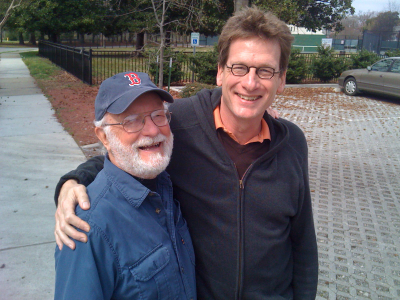
Bob Lynn, author of “Courage Vision and Heart” (see below), posed with me during a visit to Norfolk, VA in 2012.